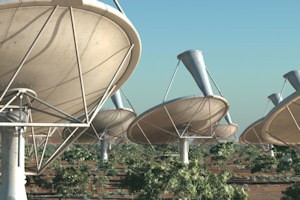
SKA will be the world’s most powerful radio telescope when operational in 2020
16 Apr 2014 The University of Manchester has been awarded more than £6 million towards its part in the design work for the international Square Kilometre Array (SKA) radio telescope. The Science and Technology Facilities Council (STFC) confirmed the funding - together with a further £13 million for other UK partners - to pay towards key SKA development and design work over the next three years. The SKA, which has its headquarters at the University's Jodrell Bank Observatory in Cheshire, will be the most powerful radio telescope array in the world when scientific observations start from 2020 and will address fundamental unanswered questions about the Universe. The combined collecting area of the hundreds of thousands of individual radio telescopes located at sites in Southern Africa and Australia will be approximately one square kilometre giving 50 times the sensitivity and 10,000 times the survey speed of today's best telescopes. The SKA will produce about 20 times the current global internet traffic in its internal tele system and one of the major challenges for scientists and engineers will be how to handle, transport and process such vast quantities of data. Manchester scientists are leading the SKA Signal and Data Transport (SADT) consortium, which will be responsible for solving these 'Big Data' issues. The group will design three data transport networks: one to take the astronomical data from the thousands of antennas to the High Performance Computer (HPC); a second network to distribute clock and synchronisation signals from a central group of very accurate clocks out to each antenna; and a third network to allow telescope control and monitoring information to flow back and forth throughout the SKA system.
TO READ THIS ARTICLE, CREATE YOUR ACCOUNT
And extend your reading, free of charge and with no commitment.