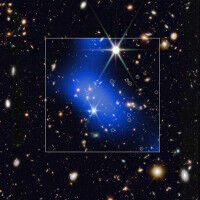
The galaxy clusters: image credit Reinout van Weeren/CfA
An international team of astronomers including Lancaster's David Sobra l have discovered a cosmic one-two punch never seen before. Two of the most powerful phenomena in the Universe - a supermassive black hole and the collision of giant galaxy clusters - have combined to create a stupendous cosmic particle accelerator. By combining data from some of the best X-ray, optical and radio telescopes in the world, researchers have found out what happens when matter ejected by a giant black hole is swept up in the merger of two enormous galaxy clusters. "We have seen each of these spectacular phenomena separately in many places," said Reinout van Weeren of the Harvard-Smithsonian Center for Astrophysics (CfA) , who led the study that appears in the inaugural issue of the journal Nature Astronomy. "This is the first time, however, that we have seen them clearly linked together in the same system." This cosmic double whammy is found in a pair of colliding galaxy clusters called Abell 3411 and Abell 3412 located about two billion light years from Earth. The two clusters are both very massive, each weighing about a quadrillion - or a million billion - times the mass of the Sun. Optical data from the Isaac Newton Telescope, in La Palma and Keck Observatory and Japan's Subaru telescope, also on Mauna Kea, Hawaii detected the galaxies in each cluster.
TO READ THIS ARTICLE, CREATE YOUR ACCOUNT
And extend your reading, free of charge and with no commitment.