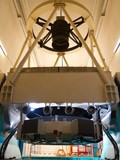
ULTRACAM on a telescope
Advances in our knowledge of planets in the outer reaches of our Solar system are being made thanks to an instrument created by experts at the University of Sheffield which observes high speed phenomena in outer space. The instrument, known as the ULTRACAM, is an ultrafast, triple-beam three-colour camera for high-speed astrophysics. It has been used in hundreds of experiments across the world - including the first look of the dwarf planet Makemake which was published this month and allowed astronomers to study its size, atmosphere and density. The sophisticated camera takes many pictures a second in three colours and allows scientists to determine how large planets are by measuring how long it takes them to pass in front of a star. This event is known as an occultation and allows scientists to learn about new planets. ULTRACAM is attached to two telescopes, one based in Chile and a second in the Canary Islands and is manned by staff from the University of Sheffield and the University of Warwick who watched as the dwarf planet blocked the light of distant star Nomad 1181-0235723, for about one minute Stuart Littlefair of the University's Department of Physics and Astronomy, said: "In astronomy, it's hard to measure the size of something accurately. Especially so for the tiny 'dwarf planets' which orbit in the outer regions of the Solar system.
TO READ THIS ARTICLE, CREATE YOUR ACCOUNT
And extend your reading, free of charge and with no commitment.