Research casts new light on processes behind solar eruptions
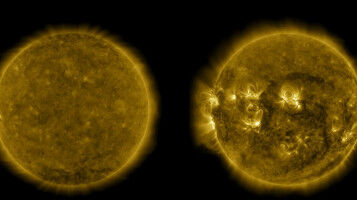
New research into the powerful magnetic fields which form inside the sun and cause violent eruptions could help predict solar flares. Mathematicians and astrophysicists from the UK and Italy have comprehensively modelled the emergence of twisted magnetic fields into the solar atmosphere, and verified their models through observations - a breakthrough in scientific understanding of the process by which solar flares occur. They describe their process and findings in a new paper published today . Their work could provide a key piece to help solve a puzzle which solar astronomers have been aiming to solve for decades - what is the origin of magnetic twist in the solar atmosphere? The answer could help to develop a better understanding of the space weather caused by radiation ejected from the surface of the sun during periods of solar activity. The most violent eruptions in the solar system are born in solar active regions, which are concentrations of highly complex, twisted magnetic fields that emerge from inside the sun and into its atmosphere. These properties are important precursors for the onset of flares and coronal mass ejections, and could form a kind of early warning system for these events once they are fully understood. Dr David MacTaggart, of the University of Glasgow's School of Mathematics & Statistics, is the paper's lead author.