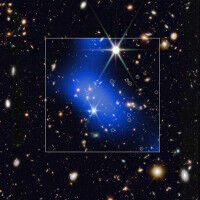
Spectacular view of the rich galaxy cluster Abell 2744 with A2744_YD4 highlighted (c) ALMA (ESO/NAOJ/NRAO), NASA, ESA, ESO and D. Coe (STScI)/J. Merten (Heidelberg/Bologna)
An astronomer from Queen Mary University of London (QMUL) is part of a team that have discovered new insights into the birth and death of the very first stars in the Universe. The team have detected an unexpectedly huge mass of glowing stardust in a galaxy seen when the Universe was only four per cent of its present age. Writing in The Astrophysical Journal Letters , the team describe how they used the ALMA telescope (Atacama Large Millimeter/submillimeter Array) and the X-shooter instrument on the European Southern Observatory's Very Large Telescope to observe A2744_YD4, the youngest and most remote galaxy ever seen by ALMA. Co-author Dr David Quénard from QMUL's School of Physics and Astronomy contributed to planning and executing the ALMA observations that revealed the extent of the dust in what is the most distant galaxy in which dust has been detected. Dr Quénard said: 'It's impressive that ALMA was able to detect such a faint object at such a huge distance - this indicates how sensitive this telescope is at low resolution.' - Cosmic Dust. The team were surprised to find that this youthful galaxy contained an abundance of interstellar dust - dust formed by the deaths of an earlier generation of stars. Lead author Dr Nicolas Laporte from University College London, said: 'Not only is A2744_YD4 the most distant galaxy yet observed by ALMA, but the detection of so much dust indicates early supernovae must have already polluted this galaxy.' Cosmic dust is composed of silicon, carbon, and aluminium, in grains as small as a millionth of a centimetre across.
TO READ THIS ARTICLE, CREATE YOUR ACCOUNT
And extend your reading, free of charge and with no commitment.