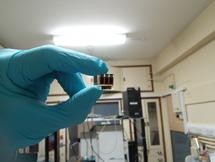
A perovskite solar cell made in an Oxford lab.
Solar cells based on a perovskite material not only excel at absorbing light but also at emitting it, turning them into low-cost lasers, a team from Oxford University and Cambridge University has shown. A relatively new type of solar cell based on a perovskite material has been pioneered by Oxford University researchers led by Professor Henry Snaith. Perovskite solar cells, which promise to be cheap and easy to mass produce, have already achieved a 17% efficiency at turning sunlight into electric energy after a mere two years of research - potentially transforming prospects for cheap large-area solar energy generation. In a new study researchers from Professor Sir Richard Friend's group at Cambridge's Cavendish Laboratory working with Professor Snaith's group at Oxford have demonstrated that, by sandwiching a thin layer of the lead halide perovskite between two mirrors, it is possible to create an optically driven laser which proves these cells ''show very efficient luminescence'' - with up to 70% of absorbed light re-emitted, turning them into cheap lasers. A report of the research is published in the Journal of Physical Chemistry Letters . 'This first demonstration of lasing in these cheap solution-processed semiconductors opens up a range of new applications,' said lead author Dr Felix Deschler of the Cavendish Laboratory. 'Our findings demonstrate potential uses for this material in tele and for light emitting devices.' Most commercial solar cell materials need expensive processing to achieve a very low level of impurities before they show good luminescence and performance. Surprisingly, these new materials work well even when very simply prepared as thin films using cheap scalable solution processing.
TO READ THIS ARTICLE, CREATE YOUR ACCOUNT
And extend your reading, free of charge and with no commitment.