


news 2014
« BACK
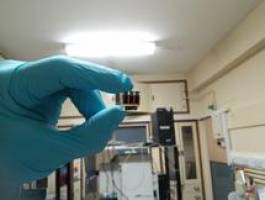 Solar cells turned into cheap printable lasers
 Memory closes in on single photons
 Brain asymmetry improves processing of sensory information
 One planet, two stars: new research shows how circumbinary planets form
 Material like '3D graphene' promises new electronics
Physics
Results 61 - 80 of 81.
Physics - 03.04.2014
“Unbreakable” security codes inspired by nature
A revolutionary new method of encrypting confidential information has been patented by scientists at Lancaster University. They have been inspired by their discoveries from human biology, which model how the heart and lungs coordinate their rhythms by passing information between each other. A mathematical model based on the complex interaction between these organs has now been transferred to the world of modern.
Physics - 31.03.2014
Solar cells based on a perovskite material not only excel at absorbing light but also at emitting it, turning them into low-cost lasers, a team from Oxford University and Cambridge University has shown. A relatively new type of solar cell based on a perovskite material has been pioneered by Oxford University researchers led by Professor Henry Snaith.
Physics - Chemistry - 28.03.2014
Revolutionary solar cells double as lasers
Latest research finds that the trailblazing 'perovskite' material used in solar cells can double up as a laser, strongly suggesting the astonishing efficiency levels already achieved in these cells is only part of the journey. Our findings demonstrate potential uses for this material in tele and for light emitting devices Felix Deschler Commercial silicon-based solar cells - such as those seen on the roofs of houses across the country - operate at about 20% efficiency for converting the Sun's rays into electrical energy.
Physics - 25.03.2014
Hunt for an unidentified electron object
New research sheds light on the nature of 'unidentified electron objects' - a mysterious class of objects that exists in superfluid helium at low temperature. The mystery of an unidentified electron object is just a teaser problem; we are ready for other challenges. Natalia Berloff Researchers have developed a new mathematical framework capable of describing motions in superfluids - low temperature fluids that exhibit classical as well as quantum behavior.
Physics - Health - 24.03.2014
When mothers are active so are their children - but many mothers are not
A study of physical activity patterns of women and their four-year-olds reveals a strong association between the two. It also shows that only 53% of mothers engaged in 30 minutes of moderate-to-vigorous activity at least once a week. Taken together, these results provide valuable pointers for policy makers.
Physics - 17.03.2014
In a world-first, an optical memory - a key component for quantum computers - has been created within a hollow-core optical fibre and shown to operate at the level of a single particle of light (a photon). Single photons of light are the basic building blocks for quantum-enhanced computers and sensors.
Physics - 12.03.2014
First thin films of spin ice reveal cold secrets
Thin films of spin ice have been shown to demonstrate surprising properties which could help in the development of applications of magnetricity, the magnetic equivalent of electricity. Published today in Nature , a team of researchers based at the London Centre for Nanotechnology (LCN), in collaboration with scientists from Oxford and Cambridge, found that, against expectations, the Third Law of Thermodynamics could be restored in thin films of the magnetic material spin ice.
Astronomy & Space - Physics - 04.03.2014
New study suggests each red dwarf star has at least one planet
Three new planets with properties that might make them suitable for life are amongst eight new planets discovered orbiting nearby red dwarf stars by an international team of astronomers, including scientists from Queen Mary University of London. The study identifies that virtually all red dwarfs - stars with masses smaller than half the mass of the Sun - have planets orbiting them.
Physics - 28.02.2014
Scientists complete the top quark puzzle
28 Feb 2014 Manchester scientists on the CDF and DZero experiments at the US Department of Energy's Fermi National Accelerator Laboratory have helped find the final predicted way of creating a top quark, completing a picture of this particle nearly 20 years in the making. The two collaborations jointly announced today (Friday) that they had observed one of the rarest methods of producing the elementary particle - creating a single top quark through the weak nuclear force, in what is called the 's-channel'.
Astronomy & Space - Physics - 25.02.2014
Research to search for Einstein’s missing link
Gravitational waves were predicted by Albert Einstein almost a century ago but they are yet to be directly detected. Scientists are now trying to measure them in an attempt not only to confirm a key prediction of Einstein's General Theory of Relativity, but also enhance understanding of the fundamental nature of our Universe.
Astronomy & Space - Physics - 10.02.2014
Massive neutrinos solve a cosmological conundrum
10 Feb 2014 Scientists have solved a major problem with the current standard model of cosmology identified by combining results from the Planck spacecraft and measurements of gravitational lensing in order to deduce the mass of ghostly sub-atomic particles called neutrinos. The team, from the universities of Manchester and Nottingham, used observations of the Big Bang and the curvature of space-time to accurately measure the mass of these elementary particles for the first time.
Life Sciences - Physics - 06.02.2014
Fish that have symmetric brains show defects in processing information about sights and smells, according to the results of a new study into how asymmetry in the brain affects processing of sensory information. It's widely believed that the left and right sides of the brain have slightly different roles in cognition and in regulating behaviour.
Physics - 06.02.2014
Do duck quacks echo? Simon Foster chats about new science show
Imperial's Dr Simon Foster sets out to solve weird and wonderful science myths in a new programme beginning this week on Sky 1 HD. Hosted by comedian Lee Mac, 'Duck Quacks Don't Echo' is a new panel show that puts science to the test. Seen as the voice of reason, Simon was quizzed by fact-obsessed celebrity panellists aiming to prove whether there is any truth behind the unbelievable and downright daft science theories they had heard to be true.
Life Sciences - Physics - 04.02.2014
Evolution: quantity over quality?
When you think about evolution, 'survival of the fittest' is probably one of the first things that comes into your head. However, new research from Oxford University finds that the 'fittest' may never arrive in the first place and so aren't around to survive. By modelling populations over long timescales, the study showed that the 'fitness' of their traits was not the most important determinant of success.
Physics - Electroengineering - 03.02.2014
Lifting the lid on silicon batteries
Resolving the mystery of what happens inside batteries when silicon comes into with lithium could accelerate the commercialisation of next-generation high capacity batteries, for use in mobile phones and other applications. Using this technique will help make battery design much more systematic, and less trial and error Ken Ogata Next-generation batteries based on silicon have come one step closer to commercial reality, after the mystery surrounding what is happening inside batteries when silicon comes into with lithium has been understood in unprecedented detail.
Astronomy & Space - Physics - 31.01.2014
Luke Skywalker's home planet Tatooine would have formed far from its current location in the Star Wars universe, a new University of Bristol study into its real world counterparts, observed by the Kepler space telescope, suggests. Like the fictional Star Wars planet, Kepler-34(AB)b is a circumbinary planet, so-called because its orbit encompasses two stars.
Physics - Mechanical Engineering - 30.01.2014
Quantum Engineers make a major step towards a quantum computer
An international research group of scientists and engineers led by the University of Bristol, UK, has made an important advance towards a quantum computer by shrinking down key components and integrating them onto a silicon microchip. Scientists and engineers from an international collaboration led by Dr Mark Thompson from the University of Bristol have, for the first time, generated and manipulated single particles of light (photons) on a silicon chip - a major step forward in the race to build a quantum computer.
Electroengineering - Physics - 20.01.2014
The discovery of a material that has a similar electronic structure to graphene but can exist in three dimensions, instead of a flat sheet like graphene, could lead to faster transistors and more compact hard drives. An international team, led by scientists from Oxford University, Stanford University, and Berkeley Lab's Advanced Light Source, has discovered that sodium bismuthate can exist as a form of quantum matter called a three-dimensional topological Dirac semi-metal (3DTDS).
Physics - Electroengineering - 15.01.2014
Superconducting spintronics pave way for next-generation computing
A breakthrough for the field of Spintronics, a new type of technology which it is widely believed could be the basis of a future revolution in computing, has been announced by scientists in Cambridge. The results offer a glimpse into a future in which super-computing could be far more energy-efficient Jason Robinson The research, reported , provides the first evidence that superconductors could be used as an energy-efficient source for so-called "spin-based" devices, which are already starting to appear in microelectronic circuits.
Physics - Chemistry - 09.01.2014
Quantum mechanics explains efficiency of photosynthesis
Light-gathering macromolecules in plant cells transfer energy by taking advantage of molecular vibrations whose physical descriptions have no equivalents in classical physics, according to the first unambiguous theoretical evidence of quantum effects in photosynthesis published today . The majority of light-gathering macromolecules are composed of chromophores (responsible for the colour of molecules) attached to proteins, which carry out the first step of photosynthesis, capturing sunlight and transferring the associated energy highly efficiently.


