Black hole trio hope for gravity wave hunt
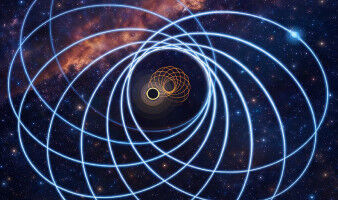
The discovery of three closely orbiting supermassive black holes in a galaxy more than four billion light years away could help astronomers in the search for gravitational waves: the 'ripples in spacetime' predicted by Einstein. An international team, including Oxford University scientists, led by Dr Roger Deane from the University of Cape Town, examined six systems thought to contain two supermassive black holes. The team found that one of these contained three supermassive black holes - the tightest trio of black holes detected at such a large distance - with two of them orbiting each other rather like binary stars. The finding suggests that these closely-packed supermassive black holes are far more common than previously thought. A report of the research is published in this week's Nature . Dr Roger Deane from the University of Cape Town said: 'What remains extraordinary to me is that these black holes, which are at the very extreme of Einstein's Theory of General Relativity, are orbiting one another at 300 times the speed of sound on Earth. Not only that, but using the combined signals from radio telescopes on four continents we are able to observe this exotic system one third of the way across the Universe.