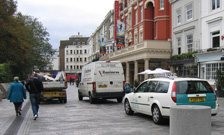
Shared space in Brighton
Local authorities 'failing to engage' when developing shared space street design, finds study. Shared space schemes for integrated street design - where segregation between cars, pedestrians and other road users are reduced or removed - have little benefit for street users, finds research led by Professor Rob Imrie from King's College London. The report, released by the Thomas Pocklington Trust, also finds that local authorities are failing to engage with people who may be disadvantaged by the schemes, such as those with sight loss and other disabilities. 'There is no clear evidence about how shared space schemes will work or what effect they will have on people's behaviour,' says Professor Imrie. 'Yet local authorities assume their benefits, and schemes have been going ahead with the concerns of people with sight loss barely heard.' The study, 'Shared space and sight loss: policies and practices in English local authorities' interviewed policy officers, and others, in ten local authorities and followed three case studies in London boroughs. It looked at why local authorities adopt the schemes and whether evidence from sight loss groups is used to inform the process. The study reveals that there is insufficient evidence to back up claims for the benefits of shared space, and there was a 'believability gap' among access officers and people with sight loss, meaning that some of the most vulnerable street users may end up avoiding the area.
TO READ THIS ARTICLE, CREATE YOUR ACCOUNT
And extend your reading, free of charge and with no commitment.