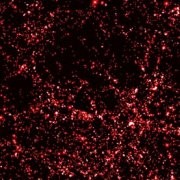
The calculated distribution of dark matter (Credits: The Virgo Consortium/Alexandre Amblard/ESA)
Scientists weigh out ingredients for the perfect galaxy. Herschel space telescope finds out how much dark matter it takes to make a galaxy - News Friday 18 February 2011 - Adapted from a news release issued by the UK Space agency and NASA - Astronomers working with Europe 's Herschel Space Observatory have found out just how much dark matter it takes to make a new galaxy bursting with stars. The discovery is a key step in understanding how dark matter - an invisible substance that pervades our universe - contributed to the creation of massive galaxies early in the life of the Universe, about 13.7 billion years ago. According to the scientists' calculations, the recipe for a perfect galaxy requires just about 300 billion times the mass of our Sun - almost 6 followed by 41 zeros kilograms - of dark matter. "If you start with too little dark matter, then a developing galaxy would peter out. If you have too much, then gas doesn't cool efficiently to form one large galaxy, and you end up with lots of smaller galaxies," said Asantha Cooray from University of California Irvine , principal investigator of the new research, which appears in Nature . "But if you have just the right amount of dark matter, then a galaxy bursting with stars will pop out." Herschel - the world's largest space telescope - launched into space in May 2009.
TO READ THIS ARTICLE, CREATE YOUR ACCOUNT
And extend your reading, free of charge and with no commitment.