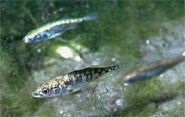
The fish appeared to be distracted by the addition of noise to their environment. Much as you or I might struggle to concentrate on a difficult assignment when faced with loud construction noise, these stickleback seemed unable to keep their mind fully on the job at hand, attending to random items of tank debris and mishandling food items more frequently when noise was played.
We all struggle to concentrate when there are roadworks taking place outside our window. New research from scientists at the University of Bristol demonstrates that fish suffer the same problem, becoming distracted from normal feeding behaviour when noise is added to their environment. Using underwater speakers to play noise at levels similar to those produced by recreational speedboats, the researchers found that three-spined sticklebacks exposed to even brief noise playback made more foraging mistakes and were less efficient at consuming the available food compared to those in quiet conditions. Dr Julia Purser , the study's lead author, said: 'The fish appeared to be distracted by the addition of noise to their environment. Much as you or I might struggle to concentrate on a difficult assignment when faced with loud construction noise, these stickleback seemed unable to keep their mind fully on the job at hand, attending to random items of tank debris and mishandling food items more frequently when noise was played.' While they did not abandon feeding behaviour entirely, as you might expect under stressful conditions, the fish were certainly less accurate and efficient in their feeding efforts during noisy conditions, even when the noise exposure lasted as little as ten seconds. The foraging mistakes are consistent with a shift in attention when exposed to noise, and in the natural environment these mistakes could be costly: increasing the chances of ingesting harmful items, and affecting the risk of predation if fish have to forage for longer to compensate for reduced efficiency.
TO READ THIS ARTICLE, CREATE YOUR ACCOUNT
And extend your reading, free of charge and with no commitment.