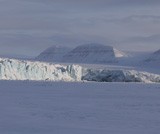
Tunabreen glacier, Norway
Experts quantify melting glaciers´ effect on ocean currents. A team of scientists from the University of Sheffield and Bangor University have used a computer climate model to study how freshwater entering the oceans at the end of the penultimate Ice Age 140,000 years ago affected the parts of the ocean currents that control climate. A paper based on the research, co-authored by Professor Grant Bigg, Head of the University of Sheffield's Department of Geography, his PhD student Clare Green, and Dr Mattias Green, a Senior Research fellow at Bangor University's School of Ocean Sciences, is currently featured as an Editor's Highlight in top US journal, Paleoceanography . The study is the first of this kind for the time period. The research found that freshwater entering the ocean from melting ice sheets can weaken the climate controlling part of the large-scale ocean circulation, with dramatic climate change as a consequence. During the period of the study, the experts noted that the global temperature dropped by up to two degrees over a few centuries, but changes were not uniform over the planet, and it took a long time for the climate to recover after the ice sheets had melted completely. The team argues that it is not only the volume of freshwater being released from the melting ice sheet which is important but also the state of the freshwater: icebergs act to reduce the ocean circulation less than meltwater, but the effects of icebergs last for longer periods of time.
TO READ THIS ARTICLE, CREATE YOUR ACCOUNT
And extend your reading, free of charge and with no commitment.