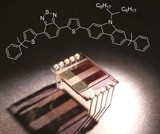
A polymer solar cell ready for testing; the metal connections allow us to measure different areas of the film and measure the device efficiency amongst other parameters. Credit: Andrew Parnell
'Cling-film' solar cells could lead to advance in renewable energy. A scientific advance in renewable energy which promises a revolution in the ease and cost of using solar cells, has been announced today (Monday 4 July 2011) following work by scientists from the Universities of Sheffield and Cambridge. A new study shows that even when using very simple and inexpensive manufacturing methods - where flexible layers of material are deposited over large areas like cling film - efficient solar cell structures can be made. The study, published in the journal Advanced Energy Materials , paves the way for new solar cell manufacturing techniques and the promise of developments in renewable solar energy. Scientists from the Universities of Sheffield and Cambridge used the ISIS Neutron Source and Diamond Light Source at STFC Rutherford Appleton Laboratory in Oxfordshire to carry out the research. Plastic (polymer) solar cells are much cheaper to produce than conventional silicon solar cells and have the potential to be produced in large quantities. The study showed that when complex mixtures of molecules in solution are spread onto a surface, like varnishing a table-top, the different molecules separate to the top and bottom of the layer in a way that maximises the efficiency of the resulting solar cell.
TO READ THIS ARTICLE, CREATE YOUR ACCOUNT
And extend your reading, free of charge and with no commitment.