


news 2013
« BACK
 Babies learn to anticipate touch in the womb
 Mutated stem cells trigger pituitary tumours in children
 Important step-forward in mission to tackle parasitic worm infections
 Test-and-treat package for HIV prevention trialled in South Africa and Zambia
 Critical gaps in breast cancer research are identified
Health
Results 101 - 120 of 538.
Health - Life Sciences - 16.10.2013
Rodents provide clues as to causes of human illness in African slums
One in five rodents in a Kenyan slum carries a disease that causes fever and illness in humans, a study has found. Scientists discovered a significant percentage of the rats and mice in Nairobi's Kibera slum - one the largest in the world - were carrying Leptospira bacteria in their kidneys. The bacteria can be passed to humans through with urine causing the disease leptospirosis which in mild forms results in fever, headache and nausea, or in serious cases can cause organ damage - when it is more commonly known as Weil's disease.
Health - 15.10.2013
Lung infections offer clue to unlocking the mystery of life-saving heart drug
Scientists from the University of Sheffield have discovered ground breaking clues as to how the pioneering heart drug ticagrelor might reduce the risk of dying following a heart attack, in comparison to previous standard treatments. The new findings, published in Platelets , show that ticagrelor may reduce the risk of dying as a result of a lung infection after suffering a heart attack compared to patients treated with the drug clopidogrel.
Health - 11.10.2013
Census reveals stark divide in health of nation
11 Oct 2013 Researchers at The University of Manchester have shown how ethnic minority groups in England and Wales have been consistently more unhealthy than the majority White population. Analysing census data from over two decades, the team find Pakistani and Bangladeshi women have long term illness rates which are 10 per cent higher than their White counterparts.
Health - Social Sciences - 10.10.2013
Prenatal depression in mothers is risk factor for depression in children as adults
Depression in pregnant women appears to increase the risk that their children are more likely to have depression when they are 18-years-old, according to a report led by University of Bristol researchers and published by JAMA Psychiatry . Depression in late adolescence is a public health issue worldwide and identifying early-life risk factors would be important to guide prevention and intervention efforts, according to the study background.
Life Sciences - Health - 10.10.2013
New hope for premature babies at risk of brain damage
Babies who suffer a bleed on their brain could be saved from debilitating brain damage after researchers at the University of Birmingham found that a new drug can prevent the swelling of the organ which causes it. The researchers found that Decorin, a drug which has been shown to have anti-scarring properties, prevented hydrocephalus - the swelling of the brain - in juvenile rats, opening up the possibility of it as a treatment for the severe condition, which, until now, has only had surgery available as a treatment.
Health - Life Sciences - 10.10.2013
Scientists break blood-brain barrier to allow cancer drugs in
Oxford University scientists have found a way of delivering drugs more effectively to treat life-threatening cancers that have spread to the brain. The study, in mice and tissue samples, used a protein called TNF that can track down sites in the brain where cancer has spread by recognising a marker found only on tumour blood vessels.
Health - Career - 09.10.2013
One in three older people experience age discrimination
New research from the English Longitudinal Study of Ageing (ELSA) reveals 33 per cent of all older people experience perceived age discrimination, with less wealthy older men being at highest risk. The study highlights the high levels of age discrimination faced by older people, a situation that worsens as they age.
Health - Administration - 08.10.2013
Aircraft noise linked to higher rates of heart disease and stroke near Heathrow
Risks of hospital admissions and deaths from stroke and heart disease are higher in areas with high levels of aircraft noise, a study has found. Researchers at Imperial College London and King's College London compared data on dayand night-time aircraft noise with hospital admissions and mortality rates among a population of 3.6 million people living near Heathrow airport.
Life Sciences - Health - 08.10.2013
Scientists unlock secret of cattle ticks’ resistance to pesticide
Scientists have discovered how a tick which transmits devastating diseases to cattle has developed resistance to one of the main pesticides used to kill it. Approximately 80% of cattle around the world, mostly in the tropics and sub-tropics, are exposed to the cattle tick - Rhipicephalis microplus - which can cause anaemia, reduced rate of growth and death, resulting in a major economic impact on farmers.
Health - Life Sciences - 08.10.2013
A slow, loving, ’affective’ touch may be key to a healthy sense of self
A loving touch, characterized by a slow caress or stroke - often an instinctive gesture from a mother to a child or between partners in romantic relationships - may increase the brain's ability to construct a sense of body ownership and, in turn, play a part in creating and sustaining a healthy sense of self.
Health - Social Sciences - 07.10.2013
We use cookies to ensure that we give you the best experience on our website. You can change your cookie settings at any time. Otherwise, we'll assume you're OK to continue. Babies learn to anticipate touch in the womb Babies learn how to anticipate touch while in the womb, according to new research.
Health - 07.10.2013
Targeted screening of ethnic minorities helps tackle heart disease and health inequalities
Targeting screening at deprived areas is a more cost effective way of identifying people in ethnic minority groups at high risk of cardiovascular disease (CVD) than mass screening and may help to reduce health inequalities. Despite recent improvements, CVD remains the leading cause of early death in the UK and many ethnic minority groups are at increased risk of the condition.
Health - 07.10.2013
IVF procedure can increase clinical pregnancy by 20 per cent
PA 313/13 A procedure called endometrial scratching significantly improves the clinical pregnancy rate — including the numbers of babies born — when performed just once in women who are undergoing assisted reproductive treatment, a study involving a University of Nottingham researcher has found.
Health - Life Sciences - 04.10.2013
A type of pituitary tumour known as craniopharyngioma appears to form via a different mechanism to that thought to occur in more common tumours, according to a paper in the journal Cell Stem Cell . The novel findings, generated by a team led by the UCL Institute of Child Health (ICH), will be further explored to better understand how cell signalling triggers the growth of such tumours - the third most common brain tumour in children - and whether new treatments could be devised to block these signals.
Health - Life Sciences - 04.10.2013
Gene variant linked to prognosis in inflammatory diseases
Researchers have identified a gene that is linked to long term disease outcome in Crohn's disease, a common inflammatory bowel disorder, and rheumatoid arthritis. The findings reveal targets that could be exploited for new treatments. The gene, which is involved in inflammation, is not associated with the overall risk of developing disease but patients with one particular variant experienced better clinical outcomes.
Health - 04.10.2013
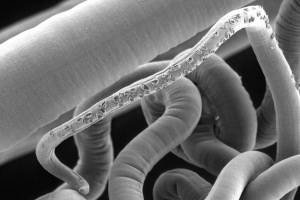
04 Oct 2013 Researchers from The Manchester Collaborative Centre for Inflammation Research (MCCIR), University of Manchester have made an important step forward in finding a potential treatment for an infection that affects over a billion people worldwide. Gastrointestinal parasitic infections, which are worm infections in the intestine, affect nearly one quarter of the world population and have been heavily linked with poverty in poorer regions.
Physics - Health - 03.10.2013
New X-ray vision can reveal internal structure of objects
03 Oct 2013 Scientists have developed a new kind of 'X-ray vision' that is able to peer inside an object and map the three-dimensional distribution of its nano-properties in real time. University of Manchester researchers, working with colleagues in the UK, Europe and the US, say the novel imaging technique could have a wide range of applications across many disciplines, such as materials science, geology, environmental science and medical research.
Health - Life Sciences - 02.10.2013
Specialised intestinal cells cause some cases of Crohn’s disease
Researchers discover that the cells play a major role in inflammation which underlies Crohn's disease in small intestine. If we are able to break down Crohn's disease into subsets by understanding the underlying mechanisms, which we have done here, we hope to develop much more targeted, effective treatments.
Health - Administration - 01.10.2013
Researchers at Imperial College London are contributing to a major study testing a combination of measures to prevent HIV in South Africa and Zambia. The study will assess whether house-to-house voluntary HIV testing and prompt treatment of HIV infection, along with other proven HIV prevention measures, can substantially reduce the number of new HIV infections across communities.
Health - Administration - 01.10.2013
Scientists from the University of Sheffield have helped a leading charity to identify critical gaps in breast cancer research which need to be urgently addressed to prevent the loss of around 185,000 lives by 2030. Four world-leading researchers, from the University's Department of Oncology, assisted the Breast Cancer Campaign (BCC) in a landmark analysis, published today (1 October 2013) in Breast Cancer Research, which shows greater investment, collaboration and renewed focus is vital.


